The Golden Valley Pilgrim Way, Herefordshire: April 2026

As with all good things - and Pilgrim walks in particular - The Golden Valley Pilgrim Way was longer in the talking and planning stage than in the actual doing; but despite that, it eventually turned out to be a lovely walk, taken in fortuitous spring sunshine amongst wonderful company.
We had been talking about this walk with Tony's brother Jeff, and his wife Sue, for a couple of years and had loosely planned to take it on in April 2025. However, as is often the case, life got in the way, and it was only after spending time walking together in December of 2025 in Madeira, that we discovered a renewed sense of urgency.
The full trail is an eight day circular loop, starting and ending at Hereford Cathedral and taking in the rolling hills, golden valleys and many small villages of the lovely Herefordshire countryside.
We planned to do the walk in two parts; the second part at some yet-undecided time in the future, but for now we would walk over four days, staying overnight at pilgrim refuges in the churches of Tyberton, Peterchurch and Madley, before returning to Hereford.
As the walk was Jeff's discovery, it fell to him to organise it. Organise it he did, and in April this year, a year later than originally planned, we set off south to Hereford, ready to embark on our adventure the next day.

Hereford is a beautiful cathedral city on the banks of the River Wye, popular for its local cider, beautiful half-timbered houses, river walks and stunning Cathedral where the Mappa Mundi and Chained Library are housed. Tonight it would also provide us with a bed for the night, and the first stamp in our pilgrim passport.
So it was, that after our evening meal, we made our way back to the 'old chapel' in the cloisters to assemble our camp beds and get an early night in preparation for our first day's walking. I have to say that, with central heating and camping beds, it was a positive start - we really hadn't known what to expect.

Day 1: Hereford to Tyberton (15 miles)
Our first day walking would take us from Hereford to Tyberton, and turned out to be quite a bit further than the estimated 11 miles.
We left Hereford, crossing over the Old Wye Bridge then taking the path west out of the city, eventually leaving the suburbs behind us. We followed the river into open countryside, where its banks were lined with graceful weeping willows, sprawling sycamores and ancient oaks, and birds darted in front of us as though leading the way.

We crossed field after field, and soon caught a glimpse of the impressive Belmont Abbey, an active Benedictine monastery and retreat centre since 1859.

A little further along the trail, we left the track following signs for Tuck Mill, hoping to come across the remains of Eaton Camp, a roman settlement that was indicated on the map. We must have missed a turn because we didn't find it, instead climbing the hill into Ruckhall and taking a narrow path alongside a large house. The house and its grounds looked newly renovated, but there had not been much thought for poor pilgrims, as the path was narrow and overgrown and the stile at the end had been replaced with a fence, meaning that we had to climb over it, with nettled legs, to continue.
We were now at the top of a small hill and could look down onto Ruckhall on one side and across to Eaton Bishop on the other, so after a short rest, we strolled down the hill and onto the lane which brought us out at the church.

We passed through Eaton Bishop, stopping to have a snack and replenish our water bottles at the church (there is an outside tap at the rear) before heading off in the direction of Madley.

At first the path continued through meadow and grazing land, knee high grass and the first of the spring wildflowers surrounding us, but soon the grass became farmed land, and we found ourselves navigating indistinct paths around crops and wading across oceans of shoulder-high yellow rapeseed, me with a scarf wrapped around my face to minimise the risk of a hay-fever attack.

The blue-green fields of early wheat were easier to cross, the ground here already arid and cracked, a result of the unseasonably warm spring weather.

Approaching Madley, and ready for lunch, we crossed another pathless field and a stile, before taking the main road into the village where the Red Lion and a very welcome pint awaited us.
After we had rested our feet and been fed and watered, we hauled on our rucksacks and continued our journey. I haven't carried a rucksack since we walked the Camino in 2024, and I had forgotten how heavy 7kg can feel, especially after a couple of pints of local cider and a nice meal.
We left Madley, once again following the trail across more fields of rapeseed and wheat, with the sun beating down even hotter than before.
At Chilstone, the trail became unclear and we were glad that we had both written directions and an OS map to cross-examine. After navigating a couple of fields, whose paths had been recently churned by the plough, and crossing quite a few broken stiles, we began to feel that maybe the local farmers disliked pilgrims, a feeling that was reinforced as we approached an apple orchard, its trees in bloom with delicate confetti blossom.

There was a fork in the path and an absence of signage. The way was unclear, and while we were studying the map, we were confronted by an unexpected sight; an old white Ford Fiesta driven by a fully kitted out beekeeper. I remember thinking that this was not a good omen, and unfortunately I was right; we had finally determined that our route would pass through the orchard in the direction the car had come from, and a few moments later we found ourselves faced with a bee hive.
The bees weren't exactly swarming, but it was clear that they had been disturbed, and were probably aware that some of their honeycomb had been taken by the fiesta driver, so we thought it fair to presume them to be disgruntled at the very least.
That said, there didn't seem to be another route, so we opted to move forward slowly, giving them a wide berth. I was worried about this for the obvious reasons, but also because Tony had experienced a bad reaction to a bee sting some years earlier, not something either of us would wish to repeat.
My concerns were well founded when I found several of them buzzing around my head. I sped up, arms flailing as I tried to waft them away with my hat, but I could feel them crawling in my hair. Managing to remain calm, (a statement that will probably cause raised eyebrows among my fellow walkers), I made my way to the hedge, and the stile to the next field, where Sue managed to swat away the remaining bees, and thankfully none of us had been stung. Nevertheless, it was an experience I don't ever want to repeat.

Slightly shaken, we continued towards Preston on Wye, where Jeff had booked us into a pub for an evening meal. The pub was only a mile and a half from St Mary’s Church in Tyberton where we would be spending the night, and after making good time, we arrived early, about an hour before it opened and two hours before we had booked to eat.
If the pub had been open, we would probably have just sat with a drink enjoying the sunshine, but it wasn't, so we had to make a decision: either walk on to Tyberton where we could dump our stuff and freshen up, before walking back to the pub to eat and then walking back again afterwards. Nobody was a fan of this option. Or we could hang around until the pub opened, eat and then walk to the church with all our kit and probably in the dark. Again - not a tempting option. It was starting to look like we would be having noodles for tea at the church, when Tony suggested, 'We could see if Uber operate round here.'
we weren't optimistic, however, to our surprise, when he put the request into the app, a taxi showed as available within ten minutes. That decided it, we would carry on to the church in Tyberton, get an Uber back to the Yew Tree to eat and then get another back to the church later.
Easy!

The route from the pub to Tyberton, however, was far from easy, traversing untended fields full of nettles and brambles with no discernible path. It took us a good hour to walk the mile and a half, at the end of which, we were hot, sweaty and starving. We dumped our packs in the church, which was cold, musty and not terribly welcoming at first glance, and then went to sit in the sunshine whilst Tony summoned an Uber.
Well, the long and short of it is that this time there weren't any takers for our request; we needed a new plan. Whilst Tony kept trying, Jeff and Sue went inside and erected the camp beds whilst I called the pub to let them know that we would be late - and may indeed not get there at all. The lovely lady that I spoke to, who remembered seeing us when we arrived at the pub earlier, took pity on us saying, 'Stay put and I'll call my partner. He'll come and get you.' What an absolute star! I went inside to share the good news, only to hear Tony shouting, 'I've got one - five minutes!'
Twenty minutes later, after another call to the pub to say 'thanks-but-no-thanks' we sat down to a very welcome drink and one of the best steak pies I have ever tasted, and later, after a repeat performance with Uber, the lovely barmaid gave us a lift back to the church in her car. Thanks to the kindness of strangers, it was a very pleasant evening.
We had an interesting night at St Mary's. It was indeed a damp and chilly church, and the only place to set our beds was either in the aisle or at the foot of the alter. We didn't want to block the passageway to the loo and kitchen, so the foot of the alter it was; I suppose it is appropriate to sleep under the watchful eye of God on a pilgrimage. The kitchen was tucked away at the back of the church and was actually thoughtfully stocked with tea, coffee and fresh milk, and also a chest containing hot water bottles and blankets crocheted by the WI - thanks ladies, they probably saved us. The toilet was a porta-loo outside in the graveyard dressed up as a shed; that was going to be an adventure in the middle of the night.

Day 2: Tyberton to Peterchurch (15 miles)
It was a chilly night, but we survived, and after a humble breakfast of instant porridge and coffee we packed up and got back on the trail. Today's journey would take us over Dorstone Hill and down the other side into Peterchurch where we would again, be staying in the local church. We should have been stopping in Dorstone, but St. Faith's was under renovation so it was going to be another long walk, around 15 miles.
The early morning walk took us from Tyberton to Bredwardine, first on a quiet track through a nature reserve and then, once again across farmland towards Moccas, home to St Michael's parish church and a Georgian country house, now a hotel but sitting on the site of an older manor house.

It was easy walking and we chatted as we ambled along, reflecting upon yesterday's journey and our night at St Mary's.
Jeff had slept soundly as was evident from his contented snoring; both Tony and Sue commented on the cold and had struggled to settle, and everyone had wondered where I had disappeared to. I had tried to settle; I was wearing thermals and had a hot water bottle so probably could have drifted off had I not had the most uncomfortable camp bed I have ever encountered. It was the type that folds in half to store, and had springs topped by a thin mattress. Unfortunately, the ancient springs were completely useless and I found myself lying across the central bars. However I twisted and turned, I couldn't avoid them so I decided to relocate, making a bed on the floor in a box pew from pew cushions. It was still chilly and I heard everyone traipse out to the 'loo-dressed-as-a-shed' at some point, but at least it was comfortable and I could rest.
With that mystery solved, we ambled along, following the course of the river into Bredwardine, which was delightful. Set above the banks of the river Wye, its church, St Andrew's, dates back to the Norman Conquest and has some unusual features, the most notable being a bend in the nave towards the altar, which means that the altar is not visible from all seats.

Being a larger village, we were hoping there would be a shop to buy refreshments, as we were about to climb to the highest point of our walk, Dorstone Hill. But we were to be disappointed: we couldn't gain access to the notable church, there was no shop and the pub only opened in the evenings.
Undeterred, onward and upward, we set off up a steep track out of Bredwardine to tackle Dorstone Hill - and boy was it steep! We left the village via a lane before crossing a stile into a field, gaining height steadily whilst slipping and sliding on the wet grass and stopping to take in the views (and catch our breath) as we climbed.

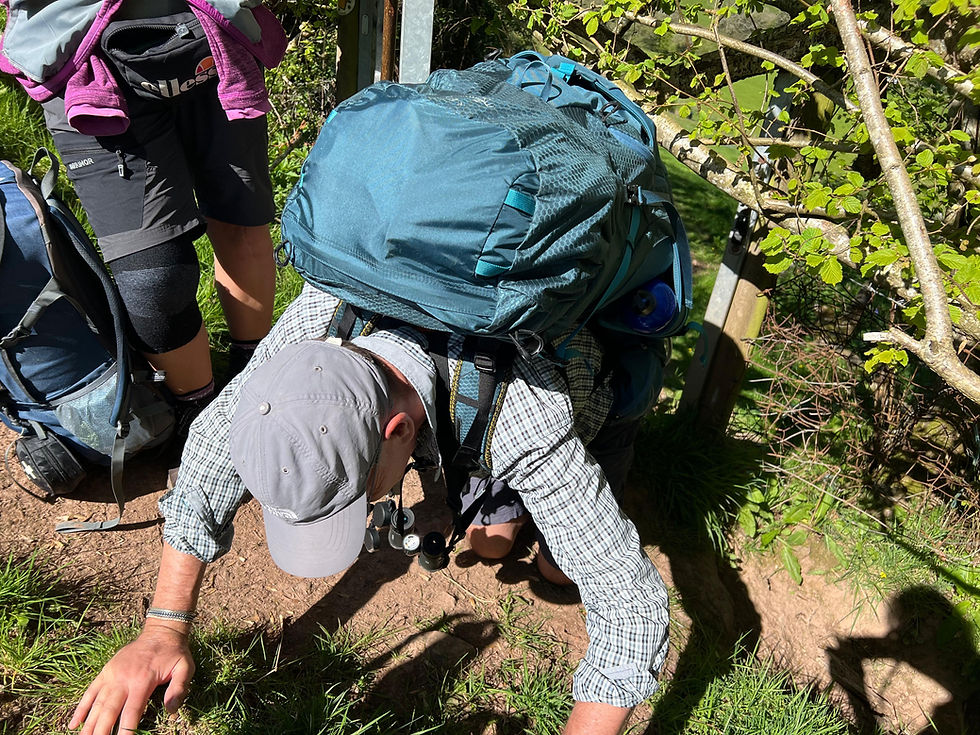
When we eventually reached the top, we had to scramble underneath a fence because the stile had been rendered useless by a low-lying branch, not easy wearing a rucksack.
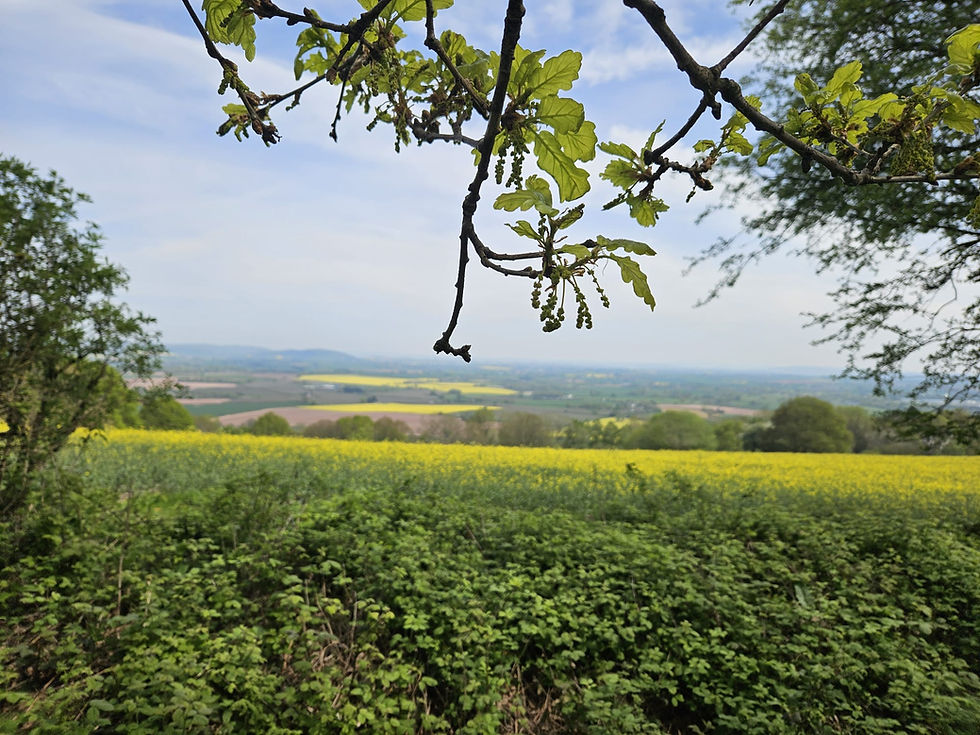
At last, we could sit back to eat a pilgrim's lunch - a cereal bar and water - and enjoy the Golden Wye Valley spread out below us.
The climb was over but we still had a long way to go, and after admiring the view, we walked up to the ridgeline to visit Arthur's Stone, a Neolithic tomb and the focal point for local Arthurian mythology.

One variation of the folklore claims that the ancient structure is the actual burial site of King Arthur himself, whilst another claims that King Arthur slew a mighty giant there, and as the giant fell, the impact of his elbows supposedly left permanent indentations on one of the large stones.
Leaving mythology behind, we walked downhill towards Dorstone, excited because the Pandy Pub was within our sights and we were really ready for a long, cold drink.
The Pandy Inn was closed. We had come to the conclusion that nobody in Herefordshire had a drink before dusk, and disappointed, we continued on our way, following a pleasant cross-country trail towards Peterchurch, where we would be spending the night.
We were walking on the road for much of this section taking us through the tiny villages of Snodhill and Hinton, (still no sign of local hostelry). As we approached Peterchurch, there was no chance of getting lost as the tall spire of the church could clearly be seen the whole way, and the last few hundred metres thankfully returned us to the fields where we followed the river path past a disused Victorian water management system and crossed a bridge to reach our destination.

Our thoughts, as we walked along the riverside, returned to our stomachs and our accommodation for the night. There are two pubs in Peterchurch - surely one of them would be open; and we needed a good night's sleep, so were hoping for somewhere a bit more modern than last nights characterful but chilly abode.
This time our luck was in on both counts. With rumbling stomachs and aching, feet we approached the Nags Head and were welcomed with open arms. We were fed and watered and engaged in conversation by the locals, who were eager to hear about our pilgrimage and to tell us about local Herefordshire life. So it was with some reluctance, that as darkness fell, we donned our rucksacks to walk the final few hundred yards to St Peter's, its church spire clearly visible over the rooftops.
We needn't have worried. St Peter's was as modern as it was charming and our accommodation was warm and inviting.

Dating back to pre-Norman times, the church features an 8th-century holy well, a Saxon altar, and a 13th-century bell tower, but its recent reinvention blends the old with the new, a wonderful modern community hub providing a cosy public cafe, a lending library and free Wi-Fi, all of which merged seamlessly with the nave. Beyond the nave was a beautiful rounded sanctuary apse with an ancient stone altar featuring five incised crosses - a rare survival from before the Reformation. The font was in a Norman rope-moulded style, and there was a domed ceiling, strikingly painted to look like the celestial firmament.
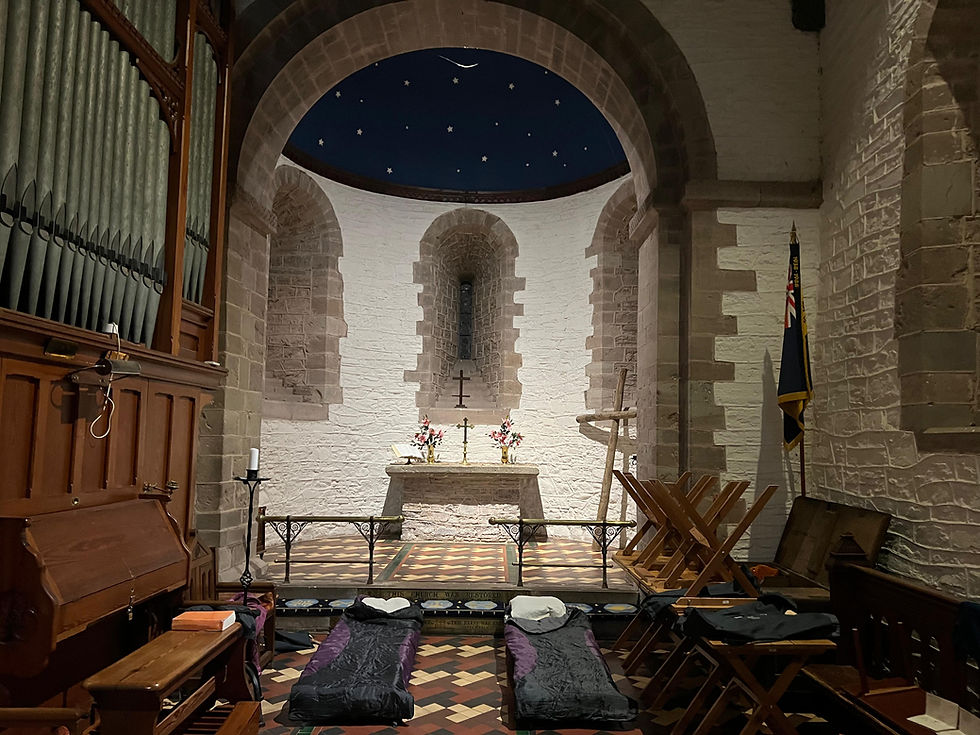
We slept in the apse, under the stars, in warmth and comfort, briefly reflecting on the day, before enjoying our best night's sleep so far.
Day 3: Peterchurch to Madley (10 miles)
Because we were walking the shortened route, today's leg would take us back to Madley where we would be spending the night in the 'Nativity of the Blessed Virgin Mary Church', said to be one of the finest church buildings in the Golden Valley; a bold statement, as we have so far been impressed by many of the buildings we have seen en-route. The thing that caught my eye about tonight's accommodation though, is that the literature 'highly recommends' that we spend the night in its acclaimed crypt; I was willing to reserve judgement until we had seen the space, but was not hopeful of being convinced; having visited many cold and damp crypts over the years, I could not imagine wanting to sleep in one.
The first part of today's walk took us uphill and then back across the valley, giving us a wonderful view back to the church, its steeple towering like a beacon above the village. After admiring the expansive landscape, we looped back to recross the road and called in at the village shop for supplies before we headed off - I was unable to resist a local pork pie which I stored away for lunchtime.
Before long we passed through the small village of Vowchurch, prettily situated on the banks of the River Dore, where there is also evidence of early medieval fortifications and an Iron Age hillfort.

A pretty grade II listed stone bridge spanned the river, delivering us to St Bartholomew's, the local parish church, which at this time of year, was enhanced by beautiful blossoming cherry trees. The church is the heart of the village, and once again dates back to the Norman period. It is particularly notable for its striking early 17th century interior woodwork, an impressive timber-framed roof structure, and a 14th century circular Norman baptismal font. The caryatids on its 17th century chancel screen are said to represent Adam and Eve, and there is a display in the church featuring the 19th century vicar, Skeffington Dodgson, (what a great name!) who was the younger brother of Lewis Carroll.
Vowchurch is a great example of the unexpected treasures you come across when walking a long route over several days, a thought I mulled over as we left the church to take our next steps.
When I walked the Camino from Porto to Santiago de Compostela a couple of years ago, I noticed the same thought patterns: my normally busy mind quietening after a few days and nature working its way in, enabling me to forget the everyday nonsense that usually clutters my brain and enter an almost meditative state, where thoughts are free to come but also easy to let go of.
We continued over Vowchurch Common, a climb, but an easy hike compared to Dorstone Hill yesterday, and dropped down into Rushen Wood to walk in the welcome cool air beneath the typically English woodland canopy.
I do love being beneath the trees, immersed in nature, and as we entered a clearing we were treated to the sight of a group of deer grazing in a pocket of sunlight. They startled when they heard us approaching, bounding off and effortlessly leaping the hedge to disappear out of sight.

We passed into Timberline Wood, the old oaks breathing around us, delivering cool oxygen to our lungs, until we emerged onto farmland, a path winding downhill to deliver us at the road into Madley.
It was nice to be reunited with the Red Lion Inn again, where civilised opening hours are observed. We sat in the beer garden and enjoyed another good meal, but once the sun dipped behind the trees, it could not be put off any longer - we needed to go and inspect the crypt.

As we approached, the first thing to note about the 'Nativity of the Blessed Virgin Mary Church' was that it was huge! Much bigger than you would expect in a village the size of Madley. The second thing that hit us was the temperature, a chilling cold that seemed to follow us back out into the sunshine; it felt quite eerie.
Built between the 11th and 14th centuries, the parish church at Madley is recognised as being one of the largest and finest in southern Herefordshire. The size and success of the church is explained by the fact that Madley was the birthplace of St Dyfrig (Dubricius), later Bishop of Llandaff, and has been a destination for pilgrims since the 6th century.
The church has many impressive and ancient features: its interior features include stained glass from the 13th century, and a 14th century sedilia with ball-flower decoration.
The renowned wall paintings tell the story of Jesus' death and resurrection: one figure shows Judas receiving bread from Jesus, another shows him betraying Jesus with a kiss in the Garden of Gethsemane. There are also very clear depictions of the Crucifixion and Resurrection as well as a rather faded Harrowing of Hell scene.
The church has a very interesting history and many more intriguing features than I have described, and if you are interested you only need to raise the subject locally - the locals are proud of their church and are keen to recount their stories, as we learned the evening before in the Nag's Head.
The crypt, which lies beneath the unusual polygonal apse (one of only three in the country) is thought to be the last medieval crypt in England. We descended the narrow, damp staircase to enter a remarkable chamber with a central pier rising up to support elegant arches and a vaulted ceiling, similar to, but much smaller than, a cathedral chapter house like the one we saw in Wells in Somerset last summer.


It's walls feature a modern triptych titled "The Lilies of the Field" created by contemporary British artist Edward Kelly. They certainly bring an unexpected flourish of vibrant colour and bold form to the ancient vaulted space and are said to aim to serve as a contemplative aid, symbolising the natural cycle of abundance, death, and new life.
I personally found the design and colours quite garish and not at all contemplative; the space was also very cold and felt damp, and by mutual consent we agreed to explore the stables instead as an alternative.
The stables were wonderful - and not a donkey or haybale in sight. In fact, the rooms were warm and dry and well equipped with a kitchen and even showers, for which were very thankful. We did, however, have to recover our camp beds from a curious 'room' in the church. The room was constructed from the remnants of a medieval screen, and I have subsequently learned that this was the private box pew of the wealthy Lulham family. It is not a private chapel, although it resembles one and if you look carefully, there is a small door through which family members would have received bread and wine during the Communion service. Why they wanted to remain apart from the rest of the congregation is a mystery, but as my Nan used to say, 'There's nowt funnier than folk.'

Day 4: Madley to Hereford (6 miles)
We arose well-rested from our night in the stables, and breakfasted well; we even smelled quite nice, thanks to the hot showers.
The walk today was short - and the last one - so we ambled along and savoured it, our feet and backs now used to the miles trod and the load carried. The way was mostly easy to remember, through woodland, across fields to the river and then into Hereford, and we didn't need to refer to the map very often.

Sue revealed herself to have a somewhat photographic memory which made life easy for the rest of us, and as we walked we reflected on the past few days.
We all agreed that the route through the Golden Wye Valley had been delightful and varied, with a few surprises on route, as is only to be expected.
The route itself was well thought out and the pilgrim passport, maps and information we received from Appledore Deanery were accurate and very professional.
One thing that was obvious (and the only real negative) is that the signage needs to be improved, and maybe a chat with the local farm-owners to ensure that paths and stiles are maintained; although we were lucky enough to enjoy a chance encounter in a pub with the lovely lady who designed the pilgrim passports, and she informed us that there are plans to carry out this work this summer.
The sanctuaries were varied and interesting and it was clear that the churches were fully invested in the project, although some were better equipped to provide a comfortable experience than others. We enjoyed the variety anyway - wouldn't life be boring if every night was the same?
We had walked through grassy meadows filled with spring flowers, across yellow and green fields of early corn and rapeseed, over hills and through woodland, alongside rivers and streams and had been privileged to explore the beautiful villages and churches of Herefordshire along the way.

We had enjoyed the kindness of strangers in pubs and sanctuaries and had also enjoyed each others' company along the way, but above all, I had once again enjoyed having the time to just 'be' in nature; to feel her embrace and hear her voice and to put to one side the minutae of everyday modern life.
As with the camino, on reaching the end I wanted to continue, to keep putting one foot in front of the other and keep building the story.

We arrived back in Hereford in a blaze of glorious sunshine and celebrated with a glass of wine overlooking the river. We ate a celebratory meal on the roof terrace of a restaurant; a wedding was taking place downstairs and their happy chatter and lively music provided a pleasant backdrop for our own little celebration.
Well done us!
It was a privilege to spend this time together, and I am sure that we will be back to do part 2 in the very near future.


Comments